
Walking the Boundaries, Bridging the Gaps: International Community Music Conference
UK-based York St. John University International Centre for Community Music (ICCM) and the Laurier Centre for Music in the Community (LCMC) invite you for a weekend conference exploring perspectives on the impact of music in a variety of community sectors at the International Community Music Conference. May 11 to 13, 2017
Heidi Ahonen: Processing Refugee Journey and Promoting Self-Healing with Music and Art
Society for Pastoral Care and Counseling – Conference 2017
SPCR 2017 Conference Theme ‘Trauma: Body, Mind, and Spirit’
The Society for Pastoral Care and Counseling (SPCR) is an unaffiliated and a registered charitable organization devoted to advancing the practice of Pastoral Care and Counseling. The Society responds to the need for a forum wherein spiritual practitioners may share and exchange experiences and ideas emerging from their work. The goal of these exchanges is to support the development of theoretical models and treatment approaches specific to the pastoral counseling profession. SPCR is for professionals and advanced students who, in their practice, value and address all of a person’s experiences, including the biological, psychological, social, interpersonal, and spiritual. A major goal of SPCR is to provide a setting for dialogue and discussion among all conference members.
This year’s conference theme is Trauma: Body, Mind, and Spirit. The individual presentations are expected to present perspectives from theory, practice and research with reference to specific aspects of the body, mind, and spirit as related to trauma. The papers should be scholarly and written in a style that is accessible for researchers, clinicians, and professionals working in the field of psychotherapy, pastoral counseling, and spiritual care.
Friday May 12, 2017
Using music as a tool of trauma psychotherapy
Speaker: Heidi Ahonen PhD, RP, MTA, FAMI.
Abstract: Music existed before written language. There has always been music for different situations, and a favourite music for every person. Music has always been used to communicate, store history, instruct, comfort, hook people together, relax, and stimulate. Many ancient civilizations knew about the power of music and used it in their healing practices. Historical explorations of music therapy and music medicine describe how rhythms, melodies, and harmonies were used to harmonize the mind and body. Many ancient physicians and healers described music as a therapeutic tool. As music therapists, we know that music has the power to heal because I have personally experienced it so many times. I know that music can make me cry and laugh, weep or dance. Music can bring one peace, or stir one up for a conflict and irritation. I fully recognize there is something in music that indeed is transformative and powerful enough to make a difference in people’s lives. I know how to communicate my deepest emotions with music! But what is it really that makes music so powerful? Is it the collective unconscious that allows us to understand each other’s music at deep, intimate levels? Is it because as human beings we actually are musical beings? Oliver Sacks (2008) writes, “we have not even begun to understand the power of music….” This paper introduces the neurological rationale for using music as a therapeutic tool when working with trauma survivors.
Music Therapy: Alternative Approaches to Psychotherapy
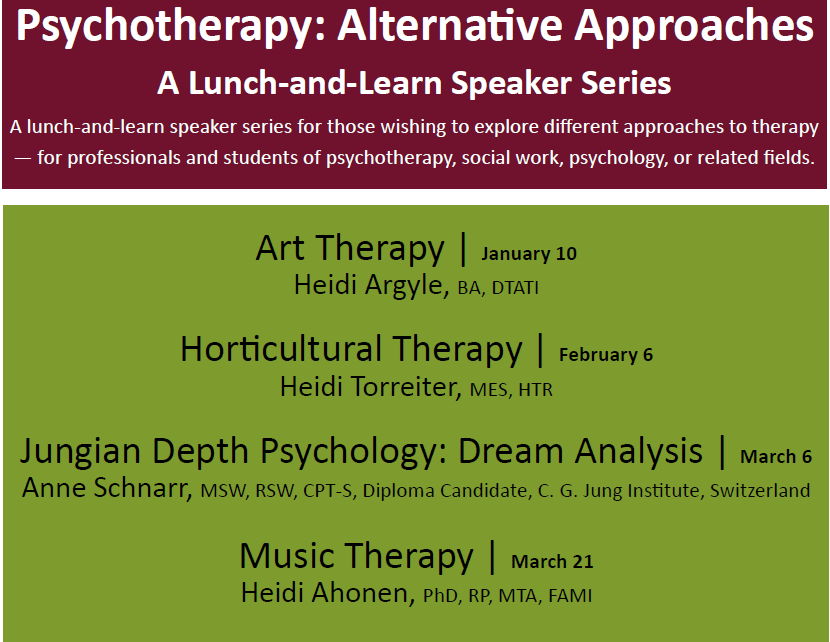
Join us for the fourth and final event in our 2017 Lunch-and-Learn Speaker Series!
Topic: Music Therapy
Speaker: Heidi Ahonen, PhD, RP, MTA, FAMI.
Psychotherapy: Alternative Approaches
A lunch-and-learn speaker series for those wishing to explore different approaches to therapy – for professionals and students of psychotherapy, social work, psychology, or related fields.
Music existed before written language. There has always been music for different situations, and favorite music for every person. Music has always been used to communicate, store history, instruct, comfort, hook people together, relax, and stimulate. Many ancient civilizations knew about the power of music and used it in their healing practices. The history of music therapy and music medicine describe how rhythms, melodies, and harmonies were used to harmonize the mind and body. Many ancient physicians and healers described music as a therapeutic tool.
As a music therapist I know that music has the power to heal because I have personally experienced it so many times. I know that music can make me cry and laugh, weep or dance. Music can bring me peace, or stir up for a conflict and irritation. I fully recognize there is something there in music that indeed is transformative and powerful enough to make a difference in people’s lives. I know how to communicate my deepest emotions with music! But what is it really that makes music so powerful? Is it the collective unconscious that allows us to understand each other’s music on a deep, intimate level? Is it so that certain melodies, harmonies, rhythms can have amazing effects on both our emotions and our perception? Or is it because as human beings we actually are musical beings? Or as, Oliver Sacks (2008) puts it, we have not even begun to understand the power of music…
This paper presentation introduces the psychological and neurological rationale for using music as a therapeutic tool.